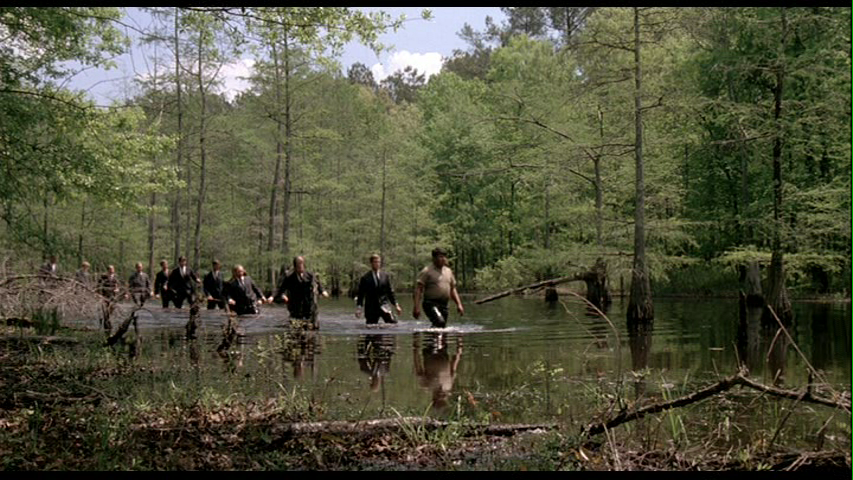
Welcome to the end of senior year. I hope your time in film class has been enlightening. You have just one more task to take care of before you go...your final exam.
Your task is to thoughtfully and thoroughly analyze a single frame of film. You should include everything we've learned this year: camera angle, mis en scene, color, contrast, staging...you know, everything. Use your notes. Go all the way. Too much is just enough. Along with the nitty-gritty film elements you've recorded in your notes, you may want to cover the following topics:
What is the subject of the frame, and how do we know?
What is the tone of the frame, and how do we know?
What story is the frame telling, and how do we know?
If possible, include the context of the frame as well as the minute and second the frame in the film occurs.
What frame should you use, and from what film? That is totally up to you. If you would like to capture your own frame, just be sure to either e-mail it to your instructor or print it off and turn it in along with your essay. Or you may select one of the frames provided below. Some are from films we have watched in class, some are from films with which you are familiar regardless, and some are from films you have never even heard of. The more familiar you are with the film, the easier the task is going to be, but the choice is yours.
A hard copy of your final exam essay is due AT THE START OF CLASS on Wednesday, MAY 30. You must personally turn it in. Emails will not be accepted.
I've written an example of what I'm looking for. It can be found HERE. Here are some links to a few more examples crafted by past students:
1. Westerns take place in one of three eras: (I) conquering the Western Frontier, (II) establishing law and order, and (III) the death of the Western Myth and the birth of the Industrial Age.
2. In the Western, the code of the West is founded in the notion of personal honor and private justice, not the abstract philosophy of law and government.
3. Common Western motifs include few against many, the life of the nameless nomadic gunfighter, man against the harsh ruggedness of nature and 'savagery.'
4. Early-to-mid century Western tales are often morality tales; later Westerns explore the ambiguity of such naivete and question whether or not life actually does have value.
5. The wandering protagonists of Westerns are quite similar to the ronins (masterless samurai) of Japanese culture.
6. Just because a film takes place in the west, does not necessarily make it a Western.
Here are a couple of scenes that really drive the point home. The first is the final gunfight from The Good, the Bad, and the Ugly, an Italian western from the 1960s. Srgio Leone was the director and, like many Italian directors from the 60s and 70s, was interested in pushing the limits of what film could do, how it could work. The result is, quite frankly, legendary. Check it out.
In the 70s, Clint Eastwood also worked with a director named Don Siegel, who directed Eastwood in several films including Dirty Harry and Escape from Alcatraz. Siegel was famous for his almost mechanical approach to filmmaking. If Leone was an artist, Siegel was a craftsman. Eastwood later took more away from his time with Siegel than Leone. The result can be seen here in the final gunfight from Unforgiven.
Here's the question: In what ways is the Leone scene an example of the formalist approach, and in what ways is Unforgiven an example of a more realistic approach. Consider pacing, camera angles, acting, editing, lighting, etc. Let me know what you think in the comments section below.