Showing posts with label Gladiator. Show all posts

Friday, May 25, 2012

Senior Final Exams


Welcome to the end of senior year. I hope your time in film class has been enlightening. You have just one more task to take care of before you go...your final exam.

Your task is to thoughtfully and thoroughly analyze a single frame of film. You should include everything we've learned this year: camera angle, mis en scene, color, contrast, staging...you know, everything. Use your notes. Go all the way. Too much is just enough. Along with the nitty-gritty film elements you've recorded in your notes, you may want to cover the following topics:
  • What is the subject of the frame, and how do we know?
  • What is the tone of the frame, and how do we know?
  • What story is the frame telling, and how do we know?
  • If possible, include the context of the frame as well as the minute and second the frame in the film occurs.

What frame should you use, and from what film? That is totally up to you. If you would like to capture your own frame, just be sure to either e-mail it to your instructor or print it off and turn it in along with your essay. Or you may select one of the frames provided below. Some are from films we have watched in class, some are from films with which you are familiar regardless, and some are from films you have never even heard of. The more familiar you are with the film, the easier the task is going to be, but the choice is yours.

A hard copy of your final exam essay is due AT THE START OF CLASS on Wednesday, MAY 30. You must personally turn it in. Emails will not be accepted

I've written an example of what I'm looking for. It can be found HERE. Here are some links to a few more examples crafted by past students:

And here some frames you may wish to choose from:

 Boogie Nights


 Cool Hand Luke


 The Descent


Gladiator


 The Grifters


 House of Flying Daggers


 The Maltese Falcon


 The Matrix


 Memento
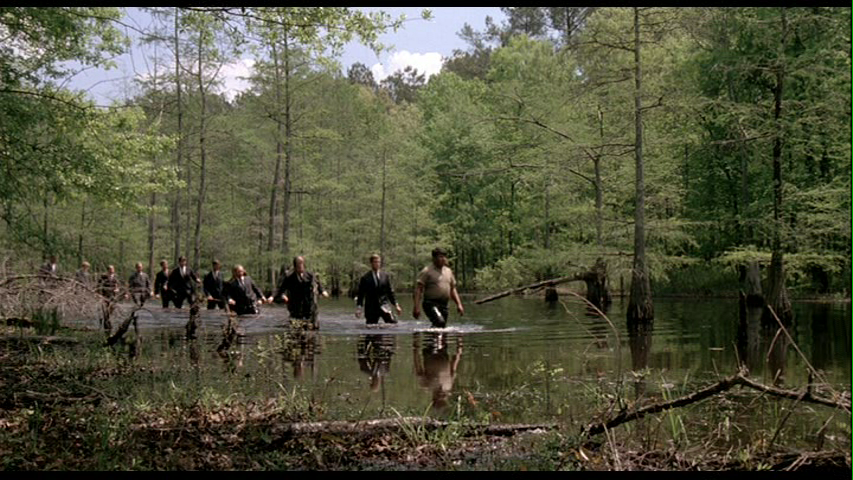

Mississippi Burning 


 Pan's Labyrinth


 Pulp Fiction


 Rear Window


 The Shawshank Redemption


 Speed


 Sword of the Beast


 Touch of Evil


 Unforgiven


 Walk the Like


Return of the Dragon

Wednesday, April 21, 2010

Gladiator 145:28

Tanya did hers on a shot that comes at the end of Gladiator.


This intense, classic movie wonder is a mixture of action, drama, and Roman history. Directed by Ridley Scott, Gladiator (2000) is a story about the life of the greatest Roman army general, Maximus Decimus Meridius, played by Russell Crowe, and how the death of the Roman emperor changes his whole world. By defeating an invading Germanic tribe, Maximus proves to the emperor that he is the best there is. Seeing this amazing defeat, the emperor, Marcus Aurelius, wants Maximus to be the heir of the throne after his death instead of his own son, Commodus. When the selfish excuse of a son, Commudus, finds out his father’s plans for the future, he manages to murder his own father simply out of greed and anger. His evil plan seems to work out because he then becomes the emperor and orders Maximus to be executed. Maximus escapes his execution and goes on a journey back home to his wife and child. Except when he finds out that his family has been brutally murdered by enemy soldiers, he loses control and gets sucked into a whirlwind of different events. Maximus goes from being an army leader, to slave, to gladiator, and then to almost emperor of Rome before being reunited with his family again in the afterlife.

At 145 minutes and 28 seconds of the movie, Maximus has just defeated Commodus in a raging battle of good versus evil. The crowd is happy for a moment, knowing that Commodus has been defeated, but as they glance upon the weary look of Maximus, they know something is about to happen. With a few last words and a final breath, Maximus closes his eyes and falls to the hard ground. He is happy to be dying because he will finally be reunited with his wife and son in the afterlife, but all around him, the people of Rome and Lucilla, Commodus’ sister, are filled with sadness.

By looking at this frame of the movie, one can tell that a lot of time and effort was put into making the set and prop design resemble a believable representation of what Rome looked like many centuries ago. The huge columns placed around the setting and the tall balconies in which the audience is seated show largeness when compared to the size of the people standing near them. Also, the various large curtains and ribbons strewn around the set show royalty of the emperor and his subjects. These few major parts of the set design make the appearance of the Colosseum look entirely realistic. The props like the swords and shields which the soldiers are holding show distinct features which would only be seen in ancient Rome. They have a sort of dark, worn out look to them. The many red rose petals scattered on the solid ground give the entire scene a look that represents victory and appreciation, in this case to Maximus for his defeat of Commodus. Lastly, the dark colors of the frame show maturity, violence, and rage. There are some light colors visible, like the color of Lucilla’s dress and the white costumes of the audience, but it is mostly the dark colors that overpower the light colors. With that in mind, one can tell that the frame is meant to be very serious and mature.

The costumes and makeup are another key part of making this scene look like ancient Rome. The soldiers are all wearing dark colored, metal armor to protect them when fighting. They are fully covered in this armor from head to toe, showing that they are royal soldiers who can afford to have all of this protection. Whereas, Maximus is only partially clothed. His arms and legs are bare and he has no head/face armor. This signifies that he is not part of the royal army, but simply a gladiator. Then we see that one particular man is clothed in a very regal manner with tall boots, a long jacket, and several badges which adorn his costume. This shows that he must be the army general. Lastly, Lucilla is wearing a fancy yellow and orange dress, which only very wealthy people could own during that time. This also puts her in a high and royal position. Although the makeup of many of the characters in this frame cannot be seen, makeup throughout this movie was used to enhance the features of the characters and add wounds to the gladiators when they fought in the Colosseum.

In this frame, the light is used to accent the meaningful story behind Maximus’ death. Therefore, the area with the most light is the area right near Maximus, while anything that begins to get farther away from him, gets darker and darker. We can already see that the light is much dimmer near the army soldiers because they almost blend into the black color of the balconies. Then, all the way in the back where the audience is seated in the balconies is where the light is the faintest because one can barely even see their faces. From the circumstances in the movie, the light source is meant to look like it is coming from the sun. In this frame, we can see that the sun is directly above Maximus and that there is some kind of small roof above the balconies because there is hardly any light there.

The way that all of the characters are positioned in this frame tells their relationship to each other. First, the way Maximus is lying right in the center of the frame shows that he is the most important thing in this frame at this moment. The farther away a character is positioned from Maximus, the less important they are. Then there’s the army general who stands as the second most important figure in this frame. He was there to witness Maximus’ death and he was there to listen to his last words. Therefore, his relationship with Maximus is rather strong. Next, almost equally as important as the army general is Lucilla. Maximus and Lucilla used to have a very strong relationship before he had gotten married, and even after his marriage, they remained close friends. Out of all people, Lucilla was the one with the most emotional connection to Maximus. This is shown by the way that she is the only one running towards him.

Taking a simple frame from a movie and breaking it down into prop and set design, costume/makeup, lighting, and staging help tell the story in a more detailed way. Looking at these various mis en scene qualities help a viewer understand the secret meaning of a movie.

How do you think this frame would be if all of the characters were an equal distance away from Maximus? Would it look as though the relationship between them is different? How big of a role does staging play in this frame?

Mr. Cowlin here. You know, Tanya has an interesting tact here. She's not just asking what is going on, but what is not going on. In other words, how would changing the elements of the shot change the message/story of the shot?
 
I am, however, wondering if Tanya's use of the term "classic" is a bit premature for this film. I don't know. Do any of you think Gladiator will stand the test of time? Why or why not?